Scientists release the biggest map of the universe. Anyone can explore its 4 bn objects
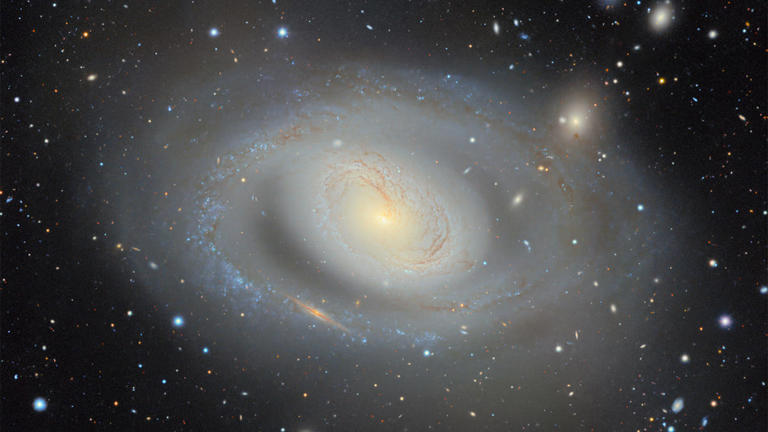
Scientists release the biggest map of the universe: The largest 2D map of the Universe ever made shows nearly four billion celestial objects, from Messier 96—a spiral galaxy about 35 million light-years away—to stars and asteroids in the solar system’s neighbourhood. Created from hundreds of thousands of telescope images stitched together over 13 years, the map lets astronomers and citizen scientists around the world comb the sky for phenomena such as dark matter and gravitational lenses.
The map comes from the DESI Legacy Imaging Surveys, which laid the groundwork for the Dark Energy Spectroscopic Instrument (DESI), a project mapping millions of galaxies and quasars to study the expansion of the Universe. DESI is led by the US Department of Energy’s Lawrence Berkeley National Laboratory.
The 5.6 trillion-pixel map builds on earlier versions from the DESI Legacy Imaging Surveys, which have been cited in more than 1,800 science papers.
“It’s part of the fabric of astronomy research now. When you are working with astronomical objects today, you often start by pulling up the Legacy Imaging Viewer to see what you are looking at,” said David Schlegel, a co-lead of the Legacy Surveys and scientist at Lawrence Berkeley National Laboratory.
The updated map provides a deep view of the extragalactic Universe not blocked by the dust and stars of the Milky Way. It covers roughly 75 per cent of the sky in visible and near-infrared light.
Deep photograph of the sky, biggest map of the universe
The Legacy Surveys map is essentially a vast, deep photograph of the sky, recording where galaxies and stars appear and how bright they are.
Astronomers can use those observations to study how galaxies clustered at different stages in the Universe’s history and trace the influence of dark energy over time.
The DESI Legacy Imaging Surveys are supported by the US Department of Energy’s Office of High Energy Physics and some other premier institutions.
In April 2026, DESI copmlete its original five-year survey ahead of schedule and with vastly more objects than expected. While it set a target of 34 million galaxies and quasars, it ended up observing more than 47 million. Results from its first three years have also thrown up a surprise: dark energy may be changing over time, rather than behaving as the constant scientists long assumed. If confirmed, it could change how scientists understand the eventual fate of the Universe.
“Explorations of our Universe always start with images of the night sky. The DESI Imaging Legacy Surveys are just one step in this venerable human tradition,” said Arjun Dey, co-lead of the Legacy Surveys in a release. “For our team, these data are fundamental to the investigation of the expansion history of the Universe and the formation of our galaxy. But the skies belong to everyone, and this survey gives everyone the chance to marvel at their wonders.”
read this also: Motorola Edge 70 Pro vs Realme 16 Pro 5G
visit this site also: studywithrahul




Post Comment