Scientists Discover a “Lost City” in the Depths of the Ocean – And It’s Unlike Anything Ever Seen on Earth
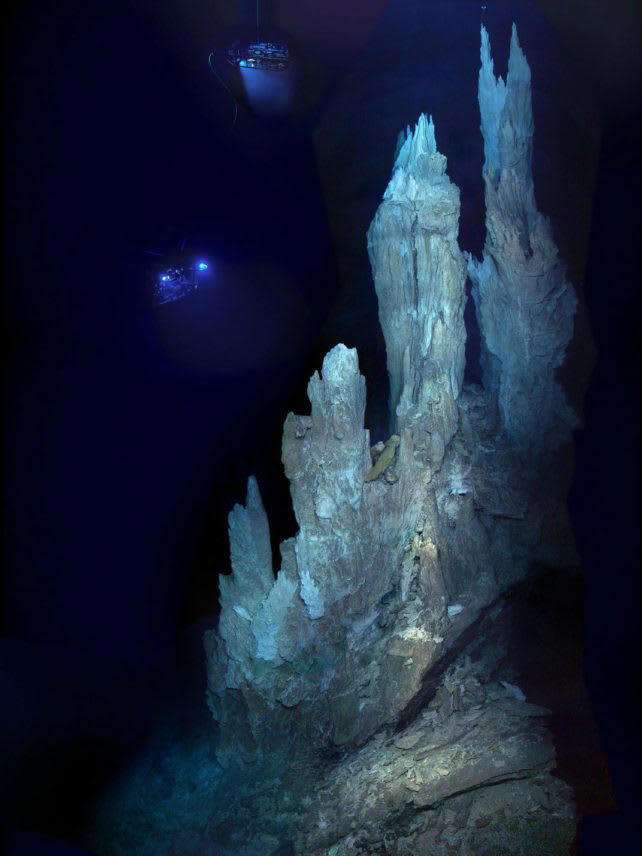
Hidden nearly 2,300 feet beneath the Atlantic Ocean, scientists have uncovered an ancient and active undersea landscape that may hold clues to life’s earliest beginnings — and even the potential for life beyond Earth.
Known as the Lost City Hydrothermal Field, this alien-like terrain was first discovered in 2000 by researchers aboard the RV Atlantis. Unlike other deep-sea vent systems, which rely on volcanic heat, Lost City is powered by a very different — and very old — mechanism: a chemical reaction between seawater and mantle rock. This process, called serpentinization, produces methane and hydrogen, the basic molecular fuel of life.
What is “Lost City”?
- Location: Discovered in 2000, it’s near the Mid-Atlantic Ridge, on the Atlantis Massif.
- Appearance: Massive, ghostly white carbonate chimneys and monoliths, some reaching 60 meters (200 ft) tall, rising from the dark ocean floor.
- Energy Source: Unlike volcanic vents, Lost City’s vents release alkaline fluids rich in methane and hydrogen, creating a chemical energy source (chemosynthesis) for life, not sunlight.
- Life: Home to unique creatures like snails, crabs, shrimp, and microbes that thrive on these chemicals, forming ecosystems similar to early Earth or potentially other planets.
- Significance: It’s the longest-lived venting system known, providing insights into how life might have started.
Recent Discoveries
- A newer, even larger field, the Kunlun hydrothermal field, has been found in the Pacific Ocean, potentially dwarfing Lost City and holding crucial keys to understanding life’s origins.
Alien Conditions Where Life Thrives in the Dark
What’s even more remarkable than the geology is the biology. Deep within the chimneys, scientists have discovered dense microbial mats clinging to the carbonate walls. These organisms survive entirely off chemical energy, feeding on the methane and hydrogen produced by the venting fluids.
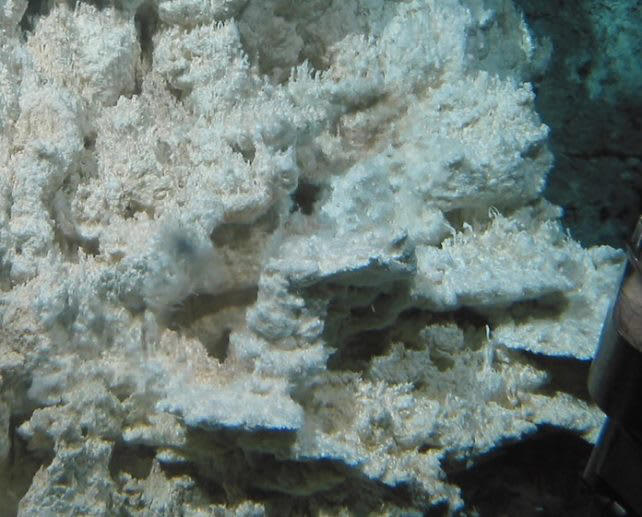
Bacteria on calcite column.© Daily Galaxy IN
Microbiologist William Brazelton of the University of Utah believes the Lost City ecosystem could offer insight into life elsewhere in the Solar System. “This is an example of a type of ecosystem that could be active on Enceladus or Europa right now,” he told The Smithsonian. These moons, orbiting Saturn and Jupiter, respectively, are known to host subsurface oceans and exhibit signs of venting activity.



1 comment